Thursday, 31 December 2009

Science, Reason & Critical Thinking: Best of 2009

On a dull October lunchtime in 2008 I decided I couldn’t be arsed to leave my desk and go to the gym, so I started a blog instead. I hadn’t planned to start a blog and had no idea what to call it, so when I was presented with the prompt “Enter the name of your blog:” I just entered “Science, Reason & Critical Thinking” as the first thing that came to mind. Perhaps with a little more planning I might have thought of something a bit more catchy like er... um… well, maybe not.

I wrote a few random thoughts on life the Universe and Everything, which I found quite therapeutic. Of course no one read a word of it, but it kept me off the cross trainer.

Things continued in much the same way for 6 months or so. Although my text never troubled the browsers of any other people, at least when someone at Skeptics in the Pub asked me the inevitable question, “What’s your blog called”, I didn’t have to confess to not writing a blog.

Much of what I wrote was merely a reworking of thoughts that had been expressed much more succinctly or eruditely by other bloggers than I could possibly accomplish with my seemingly limited grasp of my own language.

Then shortly after the preliminary hearing of the Singh BCA trial back in May, I was listening to the SGU podcast on my way to work. On an unrelated topic, Jay Novella happened to mention the Monty Python Witch Trial sketch, which just seemed to be screaming out to be re-written as “We have found a scientist, may we sue him?” Since buggering about with old Python sketches was far more fun than trying to write serious posts, I settled on a new style for my blog.

I didn’t think making silly comments and parodying existing stuff had a name, but at this year’s 9 Lessons and Carols a fellow skeptic introduced me to one of his friends as “sceptical satirist”. My wife who was in earshot sniggered to herself and later told me that she thought I was just being a silly twat, not a satirist.

Anyway, since attempting satire my blog has received a few more hits, so based on the number of visits according to Google Analytics here are my 10 most popular posts from 2009.


Simpsons Top Trumps: Skeptics Edition (62,055)
A blatant plagiarisation of Christina Martin’s excellent God Trumps, but with well known sceptics and rendered as Simpsons characters on account f the fact I can’t draw and I just happened to find a website that converts people into Simpsons characters.
Follow Up Post: A Full Deck of Simpsonized Skeptics (6,633)

Skeptic Park (20,626)
A South Park comic featuring Richard Dawkins, Ben Goldacre, Tim Minchin, Simon Singh and Carl Sagan
Follow Up Post: Skeptic Park 2 with Derren Brown (4,299)

The Ladybird book of Chiropractic Treatment & English Libel Law (13,636)
An easy to understand summary of the Singh BCA case for younger readers
Follow Up Post: The Ladybird Book of Atheist Buses (4,430)

If Homeopathy Works I’ll Drink My Own Piss (13,111)
A short video of me making a homeopathic remedy out of my own piss
Follow Up Post: Can I Get A Homeopathic Remedy Instead of A Malaria Inoculation? (4,467)

Python Plagiarising For Singh (8,319)
A rewrite of the Monty Python witch trial sketch featuring the suing of a scientist
Follow Up Post: Python Plagiarising For Singh Part 2 (412)

Skeptics Tarot Cards (3,579)
A new deck of Tarot Cards featuring a bunch of silly twats
Related Posts: Your Daily Shitoscope reading (609)

Celebrity Quack Trumps (2,737)
More Top Trump milking this time with some celebrity CAM believers
Follow Up Post: Celebrity Quack Trumps Part 2 (839)

The Homeopathy Sketch (2,086)
Is this the right room for some homeopathy?
Follow Up Post: Python In Boots (528)

God Was Never On Your Side (1,896)
My video to accompany this Motorhead classic
Follow Up Post: The Benny Hinn Show (377)

BULLSHIT By Jenny McCarthy (1,723)
A pungent stench of Bullshit from Jenny
Related Post: Reason By Richard Dawkins (1,587)


Whether or not you consider these posts to be satire or twatage, I must confess that compiling a 2009 best of may well be considered akin to John and Edward (Pointless UK TV Karaoke Eraserheads who recently enjoyed their 15 mins), releasing a Greatest Hits album.

Oh, and talking of albums, here's my best albums of 2009, and the best albums of the Noughties

Anyway that's more than enough lists, hope you’ve all had a super 2009 and all the best for 2010.

Wednesday, 16 December 2009

Reason's Greetings

from Science, Reason & Critical Thinking

1023 Sign Up

We critically thinking, rational types are well aware that the reason why homeopathy doesn’t work beyond the placebo effect is because, in all probability, there are bugger all active ingredients in any remedy above 15C. In fact, the scientifically unproven technique of like curing like means that even the remedies below 15C, that might just contain the odd molecule of the original ingredient, are hardly any more likely to work either.

However, to the uninformed majority, homeopathy is often confused with natural herbal remedies. And the fact that you can buy them from your local branch of Boots the Chemist adds an additional air of false credibility. After all we trust Boots to sell us medicines that actually work. Nevertheless, thanks to the Parliamentary Science and Technology committee we now know from the horse’s mouth that Boots sell homeopathic remedies not because there is any evidence that they are efficacious, but simply because they sell.

Perhaps they wouldn’t sell quite so well if more people were aware of what a homeopathic remedy is and how scientifically absurd its underlying principles are.

In order to try and raise awareness of the truth behind homeopathy, a while ago I cobbled together a quick video demonstrating how a homeopathic remedy is made. Much to my surprise the video proved to be rather popular but in case you missed it, here it is again:


Despite the success of the above video, a much wider reaching awareness is required, and this is where the 1023 campaign comes in. If you would like to become involved in the awareness raising campaign then please sign up here to receive more information on how you can help.

Thursday, 10 December 2009

Python in Boots

I Overheard Simon Perry in a chemists the other day talking to the director of Boots, Paul Bennett …


PERRY: 'Ello, I wish to register a complaint.

(Paul Bennett does not respond.)

PERRY: 'Ello, Miss?

BENNETT: What do you mean "miss"?

PERRY: I'm sorry, I have a cold. I wish to make a complaint!

BENNETT: We're closin' for lunch.

PERRY: Never mind that, my lad. I wish to complain about this homeopathic remedy what I purchased not half an hour ago from this very Boots.

BENNETT: Oh yes, the, uh, the 30C Wolfsbane...What's, uh...What's wrong with it?

PERRY: I'll tell you what's wrong with it, my lad. It’s ineffective, that's what's wrong with it!

BENNETT: No, no, many people believe it to be effective.

PERRY: Look, matey, I know an ineffective remedy when I see one, and I'm looking at one right now.

BENNETT: No no we sell it because, some people believe it works'! Remarkable remedy, the 30C Wolfsbane. Beautiful packaging!

PERRY: The packaging don't enter into it. It's ineffective.

BENNETT: Nononono, no, no! 'Some people believe it works!

PERRY: All right then, if people believe it works I’ll ask them!
(Shouting at other customers)
'Ello, Mister Edzard Ernst! I've got a lovely research grant for you if you tell me you believe homeopathy works

(Bennett mutters "Ja")
BENNETT: There, he said yes!

PERRY: No, he didn't, that was you doing a dodgy German accent!

BENNETT: I never!!

PERRY: Yes, you did!

BENNETT: I never, never said anything...

PERRY: (yelling and hitting the package repeatedly) 'ELLO EDZARD!
Testing! Testing! Testing! Testing! Do you believe homeopathy to be effective?
(Takes pills out of the package and swallows the lot. Throws empty packet up in the air and watches it plummet to the floor.)

PERRY: Now that's what I call an ineffective remedy.

BENNETT: No, no.....No, it’s an aggravation!

PERRY: AGGRAVATION?

BENNETT: Yeah! A healing crisis. You’ve got to get worse before you get better.

PERRY: Um...now look...now look, mate, I've definitely 'ad enough of this. That remedy is definitely ineffective, and when I purchased it not 'alf an hour ago, you assured me that its total lack of efficacy was due to it bein' diluted and succussed following a prolonged potentization.

BENNETT: Well, it’s probably your susceptibility attracting miasms.

PERRY: SUSCEPTIBILITY attracting MIASMS? What kind of talk is that? Why isn’t there any scientific evidence to support its efficacy?

BENNETT: The 30C Wolfsbane's been through several homeopathic provings. Remarkable remedy, id'nit, squire? Lovely packaging!

PERRY: Look, I took the liberty of examining that remedy when I got it home, and I discovered the only reason that some people find it effective is the PLACEBO effect.

(pause)

BENNETT: Well, o'course there’s the placebo effect. If it didn’t have the placebo effect it wouldn’t do anything. If that remedy didn’t have the placebo it couldn’t cure you.

PERRY: CURE? Mate, this remedy wouldn't "cure" if it had had four million dilutions it’s bleedin' useless!

BENNETT: No no! Its aggravations!

PERRY: It's not aggravations! It's ineffective! This remedy is useless! It is completely ineffectual! It’s a pseudo-therapy! It’s inept! Bereft of active ingredients it doesn’t work! If it wasn’t for the placebo it would have no therapeutic effect whatsoever. It’s scientifically implausible. It’s completely absurd. The purported mechanisms of its action fly in the face of our understanding of chemistry, physics, pharmacology and physiology. THIS IS AN INEFFECTIVE REMEDY.

(pause)

BENNETT: Well, I'd better replace it, then.

(he takes a quick peek behind the counter)

BENNETT: Sorry squire, I've had a look 'round the back of the shop, and uh, we're right out of effective homeopathic remedies.

PERRY: I see. I see, I get the picture.

BENNETT: I’ve got some Evening Primrose.

(pause)

PERRY: (sweet as sugar) Pray, does it cure?

BENNETT: Nnnnot really.

PERRY: WELL IT'S HARDLY A BLOODY REPLACEMENT, IS IT?

BENNETT: Look, if you go to my brother's pharmacy in Bolton, he'll sell you some science based medicine.

PERRY: Bolton, eh? Very well.

(Perry leaves)


With Special Thanks to the Merseyside Skeptics Society

Monday, 7 December 2009

Post Something You Lazy Cornish Git

Sorry for the lack of new posts in the last week, I’ve been awfully busy working on some other stuff in my spare time.

Firstly I’ve been working with Dave to set up Winchester Skeptics in The Pub. We’ve found a great venue (The Royal Oak, Winchester Town Centre), and have already booked some awesome speakers. The first meeting of Winchester Skeptics in the Pub will be on Thursday 28th January 2010. We are planning to have some very eminent guests for our inaugural meeting so please come along. More information on Winchester Skeptics in the Pub is available on the Hampshire Skeptics Society Web Page. I will be doing lots of WinSitP pimping over the next few weeks, and any help to promote these events would be most appreciated.

Also, as it’s getting near the end of the year, so I’ve been working on my 2009 album review. Not really much to do with Science, Reason & Critical Thinking, but I love music as well as science. Anyway, Rebecca Watson took a look at the list and told me I’d got it all wrong. I therefore rechecked the facts and, it turns out that she’s wrong and I’m completely correct.

I’m also working on a few other things, but hope to get back to posting my normal dubious nonsense again soon.

Friday, 27 November 2009

Come Together: Pod Delusion, Lay Science & Skepchicken

As you probably know I am an habitual contributor to the excellent Pod Delusion Podcast. My involvement was somewhat fortuitous, I just happened to be watching my twitter feed when James O’Malley sent out a tweet requesting volunteers to contribute some material.

The Podcast certainly seems to have been quite well received. I noticed we are on the New and Noteworthy front page of iTunes, and today Shalinee Singh sent me that attached snap from Time Out London who have bestowed upon us the honour of “Podcast Of The Week”. This week's is especially good BTW, even though I’m not on it and we’ve had to resort to interviewing the crazy atheist bus lady.

Anyway, all of the contributors to the Pod Delusion bring something to the table, and while we have a connected broad philosophy, we can all bring a bit of originality and different perspectives and ideas to the podcast. However, without demeaning any individual contributor, I suspect it would be hard for any one person to cover the diverse section of subjects in such detail on a weekly basis, as we are able to accomplish as a group.

This model is also now followed by the excellent Lay Science blog. Despite the success of Martin Robbins as a solo blogger, I’ll wager his new format with multiple writers allows him to reach the parts other science blogs just can't reach.

Perhaps I’m a bit late in realising this method, but it seems to me that one of the secrets to the successful promotion of Science, Reason and Critical thinking is to work together with like-minded people. However, there’s one great skeptical website that worked this out ages ago, screen shot of their blog below. [Click image to embiggen]

Sunday, 22 November 2009

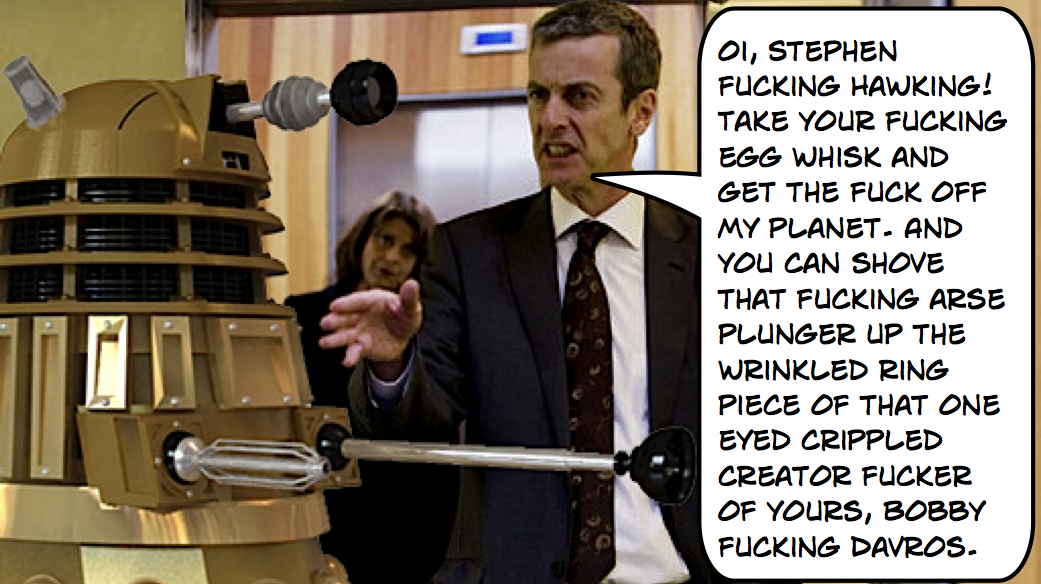
More Reasons Why Malcolm Tucker Should Be The Next Dr. Who

Richard Dawkins, Charles Darwin & Jack of Kent

I’ve been thoroughly enjoying Dawkins latest book, The Greatest Show On Earth, far superior to the commercially successful God Delusion. Anyhoo, the purpose of this post is not to attempt to review the book, just to pass comment on the final two chapters that I polished off last night.

Throughout the book Dawkins presents an arsenal of evidence, all of which gracefully converges to support Darwin’s elegant theory of natural selection as the mechanism for the fact of evolution. Each little bullet of evidence on its own is sufficient to demolish any suggestion of creationism or intelligent design. Yet, The Greatest Show on Earth acts as Dawkins Gatling gun, shredding the notion of Intelligent Design to pieces in a shower critical thinking.

The penultimate chapter focuses on the evolutionary arms race, and is one of my particular favourite chapters. As such I wanted to simply cut and paste two short paragraphs verbatim from the book.

One thing about arms races that might worry enthusiasts for intelligent design is the heavy dose of futility that loads them down. If we are going to postulate a designer of the cheetah, he has evidently put every ounce of his designing expertise into the task of perfecting a superlative killer. One look at that magnificent running machine leaves us in no doubt. The cheetah, if we are going to talk design at all, is superbly designed for killing gazelles. But the very same designer has equally evidently strained every nerve to design a gazelle that is superbly equipped to escape from those very same cheetahs. For heaven's sake, whose side is the designer on? When you look at the cheetah's taut muscles and flexing backbone, you must conclude that the designer wants the cheetah to win the race. But when you look at the sprinting, jinking, dodging gazelle, you reach exactly the opposite conclusion. Does the designer's left hand not know what his right hand is doing? Is he a sadist, who enjoys the spectator sport and is forever upping the ante on both sides to increase the thrill of the chase? Did He who made the lamb make thee?

Is it really part of the divine plan that the leopard shall lie down with the kid, and the lion eat straw like the ox? In that case, what price the formidable carnassial teeth, the murderous claws of the lion and the leopard? Whence the breathtaking speed and agile escapology of the antelope and the zebra? Needless to say, no such problems arise on the evolutionary interpretation of what is going on. Each side is struggling to outwit the other because, on both sides, those individuals who succeed will automatically pass on the genes that contributed to their success. Ideas of 'futility' and 'waste' spring to our minds because we are human, and capable of looking at the welfare of the whole ecosystem. Natural selection cares only for the survival and reproduction of individual genes.


The Final Chapter however suggests to me that Mr Dawkins has been spending some time perusing the Jack of Kent blog.

In true Jack of Kent style, Dawkins lays out the final paragraph of Darwin’s masterwork, On The Origin Of Species:


Thus, from the war of nature, from famine and death, the most exalted object which we are capable of conceiving, namely, the production of the higher animals, directly follows. There is grandeur in this view of life, with its several powers, having been originally breathed into a few forms or into one; and that, whilst this planet has gone cycling on according to the fixed law of gravity, from so simple a beginning endless forms most beautiful and most wonderful have been, and are being, evolved.

He then takes each section of each sentence in turn and subjects it to his critical analysis to determine the unequivocal meaning of the text and the underlining thoughts and ideas of the author.

Super stuff.

Friday, 20 November 2009

What do Forteans think of Skeptics?

Well, according to a recent article in the Fortean Times, Skeptics are also known as "Debunkers" or "Deniers". So with that complete misapprehension on what a skeptic is, here is a transcript from that Fortean Times article entitled: FBI Fortean Bureau of Investigation: 101 UK Spectics' 2009 Conference, Muncaster by Peter Brookesmith

The haunted castle of Muncaster in Cumbria has been in the Pennington family for some eight centuries. The castle and its estate are wonderfully maintained and have the most spectacular prospect of the mountains that hem in the English lakes. The place also has enough spooks to keep you awake for far longer than a weekend flying visit.

Muncaster has long been known as the haunt of King Henry VI (who during the Wars of the Roses hid out here after the major defeat of the Lancastrian forces at Hexham in 1464), and the ghost of an apprentice carpenter who had his head hacked off while asleep - and so naturally carries it about with him on his jaunts. The 16th century castle jester Tom Skelton, is believed to haunt the place too, and has a reputation for playing poltish pranks on those he takes against or whom he considers a threat to the Pennington family's interests. It was he who, on orders from Sir Ferdinand Pennington, loyally decapitated the luckless 'prentice, who had got above his station with the laird's daughter Helwise; so it goes. Then there is the white garbed ghost of the reputedly foul·mouthed Mary Bragg - a local girl who in the 19th century was hanged from the castle's main gate by drunken yobs. There is even a spook cat: a lion, no less, shot in Kenya by the last Lord Muncaster, has reportedly been heard growling while sauntering about the place at dusk.

Perhaps the most interesting of Muncaster's creepy stories centre on the Tapestry Room. There are huge, complex, magnetic anomalies within the room itself, and the mattress on the bed lies on a sheet of chain mail, which itself has become magnetised. The focus of the anomalies in the room happens to coincide with the position of a guest's head upon the pillow. Those sleeping in the room have reported hearing the persistent weeping of a child, a woman's voice singing, and mysterious footsteps; seeing the door open of its own accord; and feeling themselves pat led by invisible hands. Some even say they have been hurled from the bed.

Dr Jason Braithwaite, of Birmingham University, who describes himself as a brain scientist, has been investigating the room since the 1995. He says, as a good scientist would, that the reports of hauntings and the physical anomalies might be unconnected. There are a number of ideas, some of them double blind experiments, in the pipeline to test this. One of Dr Braithwaite's fellow researchers told us a nice tale of following someone up the stairs (all he could see was her legs; he assumed it was a member of the team on the premises at the time) to the Tapestry Room. Another researcher was already in the room. He saw a dark blue form enter and then seem to envelop him, before vanishing. Then the first researcher came in, and was suitably surprised not to see the person he thought he was following upstairs. If that isn't enough, there was a third person in the Tapestry Room at the time, who saw nothing at all. Pick the bones out of that if you can. Stout-hearted Hazel Muir (who was there to report on the conference for New Scientist) and her partner Tim Brown spent Saturday night in the room, jus' fer the crack, as it were. Sadly, nothing more unusual happened than Tim being kept awake because his back was giving him gyp.

Perhaps because he's known the Pennington family for years or, pel' haps, with a more ironic or provocative intent, Dr Braithwaite (who with Dr Wendy Cousins and John Jackson organised the event) thought this an excellent location for the UK Skeptics' 2009 conference, It was indeed, for one of their intentions was explicitly not to lay on a self-gratifying schmooze at which 'skeptics' (a.k.a. debunkers or deniers) [My Emphasis] could reinforce their sense of being supremely rational, superior to benighted proles. and generally the last hope of a ruinous age.

Rather, the organisers meant this to be an opportunity for those genuine sceptics, who want no more than to know what really lies behind reports of unexplained events, to exchange views and information with those with more faith in the anomalousness of anomalies but who are trying to find some hard evidence that weird things really do happen. The speakers represented a pretty fair cross-section of this population, and more work was probably done amiably exchanging views in after-hours gassing and drinking than in presentations and panel sessions. Which is how it should be. And the audience included a number of people generally committed to 'the paranormal' but ready to consider materialist or scientific interpretations. This contingent may of may not have had something of the night about them, but they had phenomenal stamina when it came to the small hours of the morning ...

When it came to official business, there wasn't a dull presentation among them. Some speakers dealt with problems in so detailed and subtle a manner that it's impossible to do them justice here. David Wilde and Dr Christine Mohr, for instance, gave intriguing talks on out-of-body experiences and near-death experiences. Mr Wilde seems to have encountered people who regarded their OBEs as revelatory (territory usually reserved for NDEers), but not to have noticed how unusual this is. Dr Mohr offered much evidence to suggest that OBEs are related to confusions at the temporo-parietal junction in the brain as it tries to process information about a person's physicai co-ordinates in space.

In contrast, Dr Wendy Cousins skimmed over the peculiar and fascinating relationship between 19th-century scientists and the bizarre goings-on in spiritualist seance halls. As I learned out-of-hours, Dr Cousins is steeped in this stuff and could probably have had the gathering's eyes even further out on stalks than they already went, for hours. So, for me, her talk ended about a day too soon.

One of the most intriguing papers was given by Karen Douglas, on conspiracy theorists, wondering like many among us what kind of person seriously entertains hard-core conspiracy beliefs. She had tested a number of people for their Machiavellian outlook (there is a well-established protocol for this) and cross-related the results to their sympathy for conspiracies. And lo, most people with devious political tendencies also go for conspiracy theories.

She then examined this sub-group, in effect asking them if, given the need and the opportunity, they would fake Moon landings, assassinate heads of state, do deals with aliens, and so on. And yes, most of them would. Dr Douglas didn't say so outright, but one might conclude from this finding that conspiracies don't so much appeal to particular individuals, as reflect, and perhaps objectify, their own outlook. It's as if, subconsciously, they are saying to themselves "I'd do that - therefore that's what they're doing."

While forteans should be glad that gatherings of this nature can occur, they should be gladder yet to hear the words of Jason Braithwaite as he kicked off the conference, and of Prof. Chris French, who's often misperceived as a dyed-in-the wool debunker, in his keynote speech. Broth had fascinating tales to tell of how the brain (or the mind) can fool itself and us. Probably as a consequence of knowing these things, both took the view that the null hypothesis in investigating apparently paranormal and anomalous phenomena should be that a scientifically explicable (or at least recognisable), 'normal' rather than paranormal set of circumstances is at work. There are literally billions of connections in the neural networks of the brain: any of them can disconnect or misconnect at any time, so no wonder we all occasionally have bizarre experiences, and some have them more than others. This approach doesn't exclude paranormal explanations: it simply asks that scientists exhaust their options before adding further hypotheses to their adumbrations.

Thus Jason Braithwaite's remark that one should beware of paranormal 'explanations' because they involve a vast number of unexamined assumptions, fell happily into the porches of mine ears. But he made the more penetrating point that simply because science can't (or doesn't bother to, I thought) explain some anomalous experiences, it's illogical to 'explain' them by calling them paranormal. Most refreshing though was his comment that the ultra-skeptical dismissal of weird experiences as merely 'all in the mind' was often intended as the end of the story, whereas it should be the start of a conversation. Likewise, Chris French commented that anomalous psychology shouldn't be seen as agaillst parapsychology, but as another way of trying to "see if there's anything there. Whatever we find out still tells us a lot about our own psychology." All this echoes what a group of British forteans have been saying among themselves for years.

Drs Braithwaite and French also stressed the power of context and prior beiief in interpreting odd experiences. Given a widespread perception of 'creepiness' in Muncaster's Tapestry Room, people are primed to translate the mundane into the spooky. Given that rock music is intrinsically wicked, some people will be able to discern Satanic messages therein, as long as the music is played backwards. It would have been good to have a social scientist or an anthropologist or al least a psycho-socialist anomalist on stage to broaden the discussion of this aspect of things, for 'context' is a word with a wide reach. Such a contributor could also have shaded in Chris French's rather simplistic ascription of alien-abduction experiences to sleep paralysis. The conundrum has many more triggers than that.

The next UK Skeptics' conference is loosely scheduled for 2011. Seats are extremely limited, but forteans should be there if they can.

PETER BROOKESMITH


NB For my definition of skeptic see this old post here

Wednesday, 18 November 2009

Hampshire Skeptics

I have been talking to Dave from the Hampshire Skeptics Society with a view to setting up a “Skeptics in the Pub” in Hampshire in the near future.

We need to ensure that we have a suitable audience so if you live in or around Hampshire and would be interested in attending a Hampshire SitP event, please register on the Hampshire Skeptics society group and/or join the Hampshire Skeptics group on Facebook.

More information soon when we’ve selected a suitable pub and formalised a few speakers.

Friday, 13 November 2009

MRI Brain Scan

Ever since the human brain evolved a conscious understanding of itself, its inner workings have been a cause of fascination and intrigue. Recent scientific developments in Magnetic Resonance Imaging (MRI) have started to allow neurologists a glimpse at what is going on inside the human brain. By combining the MRI technology with recent software developments, Science, Reason and Critical Thinking are now able to bring you exclusive new video footage revealing startling new evidence in the understanding on male psychology.

The Pod Delusion: Episode 9


This week:
EXCLUSIVE: Skeptical Voter Launch (0:49) by Richard Wilson
Glenn Beck 1990 (3:45) by Salim Fadhley
Hollywood Skepticism (9:54) by Jon Treadway
Skepticism vs Denial (16:00) by Crispian Jago
Downloading TV (20:57) by Mark Thompson
Large Hadron Collider (25:49) by Professor Wilhelm Howells

And here's the link to the Skeptical Voter website mentioned in the podcast